
Children & Families
Punjab 5 Marla Plot Scheme
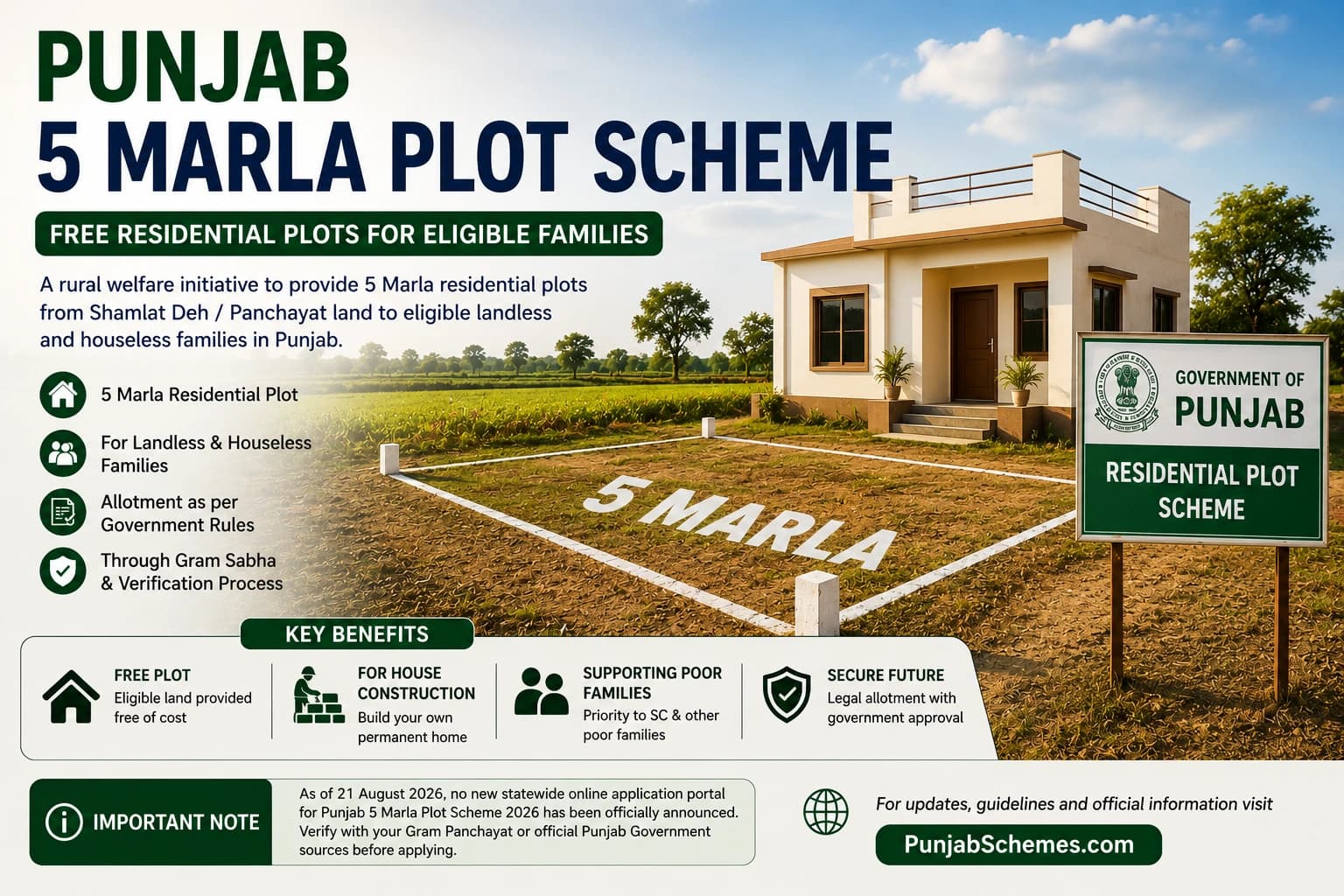
Punjab's rural 5 Marla residential plot framework allows eligible landless and houseless persons to be considered for free residential plots from available Shamlat Deh or Panchayat land, subject to Gram Sabha identification, verification, government approval and the applicable rules.
Scheme overview
The Punjab 5 Marla Plot Scheme is the commonly used name for a rural housing-welfare framework under which eligible landless and houseless residents may be considered for residential plots from available village common or Shamlat Deh land. The legal foundation is Rule 13-A of the Punjab Village Common Lands (Regulation) Rules, 1964. It permits a Panchayat, with previous approval of the Government, to give Shamlat Deh land free of cost to a landless worker residing in the Sabha area for construction of a residential house.
Punjab later framed a policy dated 17 April 2001 for allotment of free 5 Marla plots to eligible Scheduled Caste families and other poor families for construction of houses. Punjab and Haryana High Court decisions have described how the policy operates: the concerned Gram Panchayat convenes a Gram Sabha meeting, eligible beneficiaries are identified, a resolution is passed and the claims are then verified by the prescribed authorities before allotment can be completed.
The Punjab 5 Marla Plot Scheme should therefore not be understood as an ordinary housing lottery in which every resident can submit an online form and automatically receive free land. Availability depends on the applicable government policy, beneficiary eligibility, village-level identification, availability and legal status of Panchayat or Shamlat Deh land, verification and approval by competent authorities.
Search interest for terms such as Punjab 5 Marla Plot Scheme 2026, Punjab free plot scheme, 5 Marla Plot Scheme Punjab apply online and Punjab 5 Marla Plot Scheme registration can rise rapidly whenever a new housing or land-allotment announcement is expected. Applicants should distinguish a genuine new government notification from the older legal and policy framework described on this page.
As of the last review of this guide on 21 August 2026, PunjabSchemes.com has not verified a fresh statewide Government of Punjab notification opening a general 2026 online application portal for free 5 Marla plots. This page will be updated if Punjab announces a new application window, beneficiary survey, district-wise programme, Gram Sabha identification exercise or official registration portal.
Until a fresh official announcement is available, residents should verify implementation with the concerned Gram Panchayat, Block Development and Panchayat Office, District Development and Panchayat Office or district administration. Avoid paying private agents who claim that they can guarantee a plot or add a name to a government beneficiary list.
Benefits at a glance
- Residential land of approximately 5 Marla under the applicable Punjab policy and local allotment process
- Eligible Shamlat Deh or Panchayat land may be provided free of cost where the legal and administrative conditions are satisfied
- The land is intended for construction of the beneficiary's own residential house
- The framework targets eligible landless and houseless rural households rather than general property buyers or investors
- Beneficiary identification involves Gram Sabha or Gram Panchayat processes followed by administrative verification
- Final allotment depends on suitable land being legally available and government approval being obtained
- Rule 13-A restricts sale, exchange or mortgage of land allotted under the provision, except mortgage for raising a loan to construct the house
Who may apply
The historical Punjab policy primarily covers eligible landless and houseless rural residents, including specified Scheduled Caste and other poor families, subject to residence, housing or land ownership and other conditions verified through the Gram Sabha, Gram Panchayat and competent authorities.
- The applicant should be a resident of the concerned Gram Sabha area
- The applicant should satisfy the landless or houseless condition under the policy currently being applied
- Under the historical policy, the beneficiary should not already have a house or suitable residential land for construction of a house
- The historical scheme included specified Scheduled Caste and other poor or houseless categories
- Any category, income, family or marital-status conditions in a fresh notification must be checked from the current official rules
- The applicant must pass the local and departmental verification process
- The applicant's identity, residence, family and land records should be consistent
- Actual allotment also depends on suitable Panchayat or Shamlat Deh land being legally available for residential use
Department
Department of Rural Development and Panchayats, Government of Punjab
Application fee
Rule 13-A provides for eligible Shamlat Deh land to be given free of cost for construction of a residential house. No current statewide 2026 online application fee or application portal has been verified for this guide.
Documents to prepare
- Proof of residence in the concerned Gram Sabha area
- Aadhaar card or another identity document accepted by the competent authority
- Family or household record requested during beneficiary verification
- Evidence or declaration showing that the applicant does not own a house or suitable residential land, where required
- Scheduled Caste or other applicable category certificate, where the claim depends on category
- Marriage or family-status evidence if required under the policy currently being applied
- Any land, income, BPL or local-verification documents requested by the Gram Panchayat, BDPO, DDPO or district administration
How to apply
- First confirm with the concerned Gram Panchayat whether 5 Marla residential-plot identification or allotment is currently being undertaken in the village
- Ask whether a Gram Sabha meeting, beneficiary survey or resolution has been scheduled or completed
- Submit the identity, residence, landlessness, housing-status and category evidence requested by the competent local authority
- Ensure the applicant's name is correctly recorded during Gram Sabha or Panchayat beneficiary identification
- The proposed beneficiaries may undergo verification through Panchayat, Block, District and other competent authorities before final approval or possession
- Keep copies of every application, resolution reference, acknowledgement and verification document
Before you submit the application
- Ask the Gram Panchayat whether a beneficiary list, Gram Sabha meeting, survey or resolution relating to residential plots currently exists in your village.
- If someone says a Punjab 5 Marla Plot Scheme 2026 application has opened, ask for the official Government notification number or a punjab.gov.in link before submitting documents.
- Do not pay an agent for guaranteed inclusion in a beneficiary list. Selection and verification are administrative processes and cannot legitimately be guaranteed by a private intermediary.
- Keep residence, caste, family and identity records consistent. Differences in names, father's or spouse's name, address or household records can delay verification.
- If the family owns inherited, jointly held or disputed residential land, disclose it and ask the competent authority how it affects the landless or houseless eligibility test.
- Keep copies or photographs of any Gram Sabha resolution, beneficiary-list entry, application acknowledgement or verification notice relating to the claim.
- Do not occupy Panchayat land merely because a scheme is being discussed. Legal allotment and possession should follow the official approval process.
- Do not purchase or privately transfer a plot represented as a government-allotted 5 Marla plot without checking the allotment conditions and land records.
- Do not confuse Punjab, India with Punjab, Pakistan. Search results for 5 Marla schemes frequently surface Pakistan housing programmes that have completely different eligibility rules and application portals.
How 5 Marla plot identification and allotment works in Punjab
The Punjab 5 Marla residential-plot process is fundamentally different from a normal development-authority plot draw. Under Rule 13-A, the starting point is village common land and an eligible landless worker residing in the Sabha area. The Panchayat cannot simply distribute land informally: the provision requires previous approval of the Government. The 17 April 2001 policy described in Punjab and Haryana High Court decisions added a beneficiary-identification structure in which the Gram Panchayat convenes a Gram Sabha meeting, identifies persons who satisfy the policy conditions and passes a resolution. Proposed beneficiaries then undergo verification at the prescribed administrative levels.
Availability of land is a separate issue from personal eligibility. A person may satisfy the landless and houseless conditions but still not receive a plot immediately if the village does not have suitable Shamlat Deh land available for residential allotment or if the land is affected by possession, title, reservation, litigation or another legal restriction. The existence of Panchayat land also does not permit a person to occupy it in anticipation that a future scheme will regularize possession.
Court proceedings illustrate why verification matters. In one Punjab case, a Panchayat resolution initially included 74 proposed beneficiaries, while later verification found 55 eligible. This demonstrates that inclusion in an initial Gram Sabha or Panchayat list does not necessarily mean final allotment. Eligibility can still be examined by Block, District and other competent authorities before possession or final allotment is given.
The beneficiary should also understand the restrictions attached to land allotted for residential welfare. Rule 13-A restricts sale, exchange and mortgage, except mortgage for raising a loan to construct the residential house. Court records concerning the historical policy also refer to construction and resumption conditions. The allotment letter must therefore be preserved and read carefully before any transfer, mortgage or change in use is considered.
For people searching Punjab 5 Marla Plot Scheme 2026, Punjab free plot scheme 2026, 5 Marla plot apply online Punjab or Punjab 5 Marla registration, the most important distinction is between an existing legal framework and a new government launch. The existence of Rule 13-A and the 2001 policy does not by itself prove that Punjab has opened a fresh statewide application window in 2026.
If a new Punjab 5 Marla Plot Scheme is announced, the official notification should settle the high-intent questions users are searching: who can apply, whether Scheduled Caste or other categories receive priority, whether there is an income ceiling, which districts and villages are included, where the land will come from, whether applications are online or Gram Sabha based, what documents are required, the last date, how beneficiary lists are published and how allotment status can be checked.
Applicants should be particularly cautious with websites, social-media posts and videos that display an Apply Online button before Punjab has announced an official portal. Aadhaar numbers, caste certificates, bank-account information and family records are sensitive. They should only be supplied through a verified Punjab Government service, an authorized Sewa Kendra or an authority identified by the official notification.
Search results also require care because Punjab is the name of a state in India and a province in Pakistan. Pakistan programmes involving small residential plots use Pakistani institutions, identity requirements and application systems. They have no connection with the Indian Punjab Panchayat-land framework described here. Indian residents should verify information through Government of Punjab, India, Rural Development and Panchayats, the concerned district administration or Gram Panchayat.
How to read the eligibility rules
Start with the eligibility conditions for Punjab 5 Marla Plot Scheme, but do not treat any single condition as the whole test. Government schemes normally require every applicable condition to be satisfied together. A person may appear to fit the broad beneficiary description and still need to prove age, residence, family circumstances, registration status, income, contribution history or another scheme-specific fact. Read the checklist from beginning to end and mark each item as confirmed, uncertain or not applicable before spending time on the form.
Where this guide says that a requirement must be confirmed, that is deliberate. Department of Rural Development and Panchayats, Government of Punjab remains the deciding authority, and an official may need to examine records that are not visible to an information website. If your circumstances sit near a threshold, or the official document does not publish the latest threshold, ask the department or authorized service centre to confirm the rule in force on the date you apply. Keep a note of the office, date and guidance received.
Preparing a reliable document file
A strong application file is consistent as well as complete. Compare the applicant's name, parent's or spouse's name, date of birth and address across identity documents, certificates and the bank passbook. Small differences such as initials, translated spellings, an old village address or a changed surname can cause a record to be held for clarification. If a correction is necessary, begin it before submitting Punjab 5 Marla Plot Scheme; attaching several conflicting documents usually does not resolve the underlying mismatch.
Carry original documents for verification and keep clear copies for submission. Scan or photograph the complete page in good light, without cropped corners, glare or unreadable seals. For certificates, check the issuing authority, certificate number and date. For bank evidence, make sure the beneficiary's name, account number and IFSC are visible. Never hand over an original permanently unless an official written process specifically requires it, and never share an Aadhaar OTP, bank OTP, PIN, password or card security code with an agent.
Completing the application correctly
Use only the application route currently recognized by Department of Rural Development and Panchayats, Government of Punjab. If assisted registration is available, the operator should enter information from your documents rather than guessing. Review every field before final submission, especially category, date of birth, relationship details, registration number, bank account and mobile number. A wrong category or transposed bank digit can affect both eligibility checking and payment. Ask for corrections while the application is still open instead of assuming they can easily be made later.
When a declaration appears on the form, read it before signing or authenticating. The declaration makes the applicant responsible for the information supplied and may permit verification against government databases. Do not omit an inconvenient fact or select an inaccurate answer merely to move past a required field. If the form does not provide a suitable option, ask the authorized centre how the case should be recorded. Submit every mandatory attachment and obtain an acknowledgement, receipt or application number before leaving.
What happens after submission
Submission is not the same as approval. The application may pass through document scrutiny, database matching, local verification and sanction by the competent authority. Some schemes also require confirmation from an educational institution, medical authority, labour office, local body or bank. Processing time therefore varies by case and workload. Use the acknowledgement number when asking for an update and allow the official channel a reasonable period before escalating a newly submitted application.
If the status shows a query, deficiency or objection, first obtain the exact reason. Correct that issue with the appropriate evidence rather than filing repeated duplicate applications. If an application is rejected, ask whether the system provides reconsideration, appeal or a fresh-application route and note any deadline. Keep the rejection message or order. It is far more useful for resolving the case than an informal statement that the application “did not work.”
Frequently asked questions
What is the Punjab 5 Marla Plot Scheme?
It is the commonly used name for Punjab's rural welfare framework under which eligible landless and houseless persons may be considered for residential plots from available Shamlat Deh or Panchayat land. Rule 13-A provides the legal basis for giving qualifying land free of cost for construction of a residence.
Has the Punjab 5 Marla Plot Scheme 2026 been launched?
As of 21 August 2026, PunjabSchemes.com has not verified a fresh statewide Government of Punjab notification opening a new general 2026 online application process for free 5 Marla plots. The underlying legal provision and the older 17 April 2001 policy are genuine, but any fresh launch should be confirmed through an official Punjab Government notification.
Is Punjab 5 Marla Plot Scheme online registration open?
No current statewide 2026 online registration portal has been verified for this guide. Do not submit Aadhaar, bank, caste or family information to an unofficial website claiming that registration has opened unless the Punjab Government confirms the portal.
How can I apply for the Punjab 5 Marla Plot Scheme?
Historically, beneficiary identification has involved the Gram Sabha, Gram Panchayat and subsequent administrative verification. Residents should first ask the concerned Gram Panchayat whether beneficiary identification or allotment is currently underway and what documents or application procedure are being used.
Who may be eligible for a free 5 Marla plot in Punjab?
The historical policy concerned eligible landless and houseless rural residents and included specified Scheduled Caste and other poor families. Residence in the concerned Gram Sabha area and lack of a suitable house or house site have been important conditions. Any new notification may modify eligibility.
Is the Punjab 5 Marla plot completely free?
Rule 13-A permits qualifying Shamlat Deh land to be given free of cost for construction of a residential house. This does not mean every applicant is entitled to a plot. Land availability, beneficiary eligibility, verification and government approval still apply.
Where can I get the Punjab 5 Marla Plot Scheme application form?
No current statewide 2026 application form or official online registration portal has been verified. Check with the Gram Panchayat, Block Development and Panchayat Office, district administration or an official Punjab Government source before using any form found online.
What documents may be required for the Punjab 5 Marla Plot Scheme?
Typical verification can involve identity, Punjab residence, family record, landlessness or housing-status evidence and applicable caste or category documents. The exact document list must come from the authority handling the current allotment process.
How is the beneficiary list prepared?
Court records describing the historical policy show a process involving Gram Sabha identification, a Gram Panchayat resolution and subsequent verification by prescribed authorities. Inclusion in an initial list should not be treated as final approval until verification and allotment are completed.
Can I check Punjab 5 Marla Plot Scheme beneficiary status online?
No statewide 2026 online status-check portal has been verified. Where a local identification process exists, status may need to be checked through the Gram Panchayat or the competent block or district authority.
Can a beneficiary sell a government-allotted 5 Marla plot?
Rule 13-A restricts sale, exchange or mortgage of land allotted under the provision, except mortgage for raising a loan to construct the house. The beneficiary must also follow any additional conditions stated in the allotment letter.
Is the scheme only for Scheduled Caste families?
The historical 2001 policy included eligible Scheduled Caste families as well as other poor families. The exact categories covered by any fresh implementation or new 2026 scheme should be checked from its official notification.
Does every Punjab village have 5 Marla plots available?
No. Personal eligibility does not itself create land. Actual allotment depends on suitable Panchayat or Shamlat Deh land being legally available in the concerned area and approved for the purpose.
Is Punjab's 5 Marla scheme the same as Pakistan's housing schemes?
No. This guide concerns Punjab state in India. Programmes operating in Punjab province, Pakistan use different laws, identity systems, authorities and application portals.
What should I do if a new Punjab 5 Marla Plot Scheme is announced?
Check the official notification first. Confirm the launch date, eligible districts or villages, beneficiary categories, application dates, documents, selection process and official application or status channel before sharing personal information.
Official source and verification
We reviewed the government material linked below and summarized it in plain language. Scheme rules, amounts, deadlines and service channels can change; use the official source for the final check before applying.
Visit the official government source
Related Punjab schemes
Continue comparing verified guidance before deciding which programme matches your circumstances.

Dependent Children Pension Scheme - Punjab
Punjab's social-assistance service for eligible dependent children where parental death or disability conditions apply.
View scheme guide
National Family Benefit Scheme - Punjab
One-time family assistance for an eligible Punjab BPL household following the death of its primary earning member, subject to current departmental verification.
View scheme guide
Mukhya Mantri Sehat Yojana Punjab
Punjab's universal health scheme providing eligible resident families cashless hospitalization cover of up to ₹10 lakh per family per year at empanelled government and private hospitals.
View scheme guide