
Health
Mukhya Mantri Sehat Yojana Punjab
Punjab's universal health scheme providing eligible resident families cashless hospitalization cover of up to ₹10 lakh per family per year at empanelled government and private hospitals.
Scheme overview
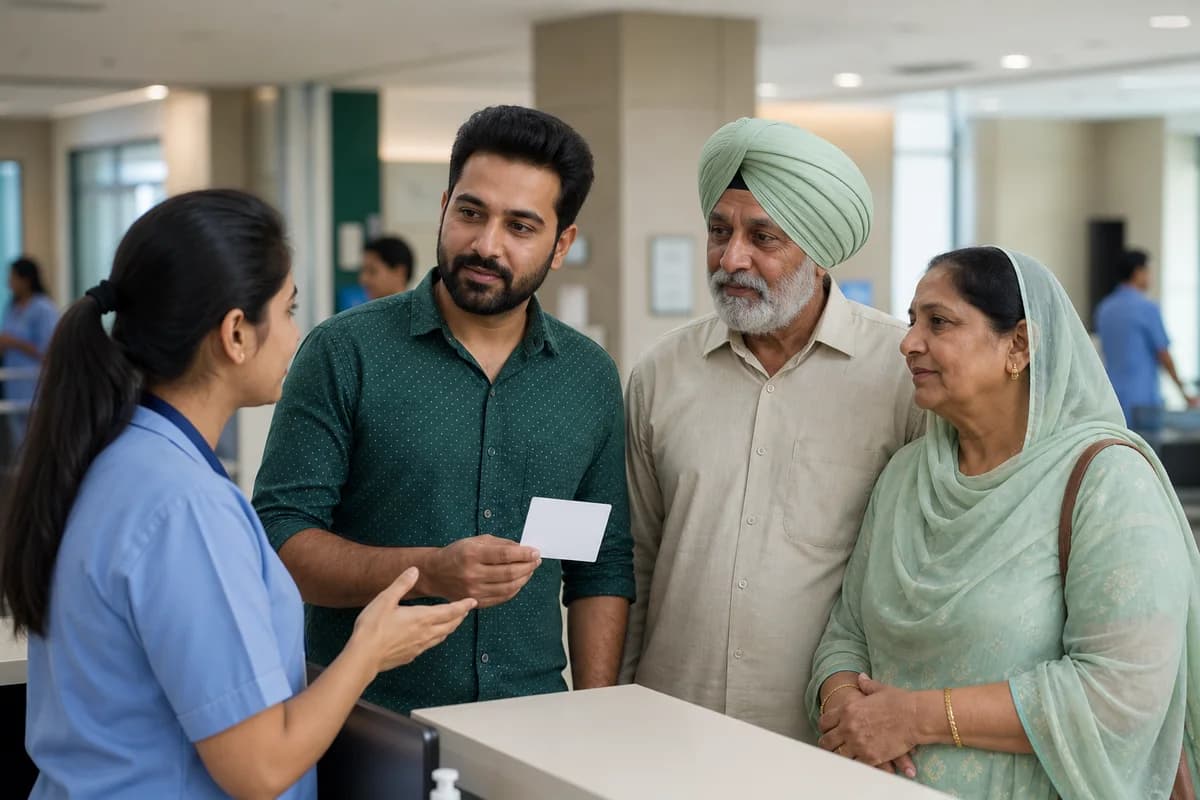
Mukhya Mantri Sehat Yojana (MMSY), widely searched as Mukh Mantri Sehat Yojna, is Punjab's universal cashless-hospitalization programme. Punjab announced universal family coverage of up to ₹10 lakh per year and rolled out the present scheme in January 2026. The State Health Agency under the Department of Health and Family Welfare administers registration, hospital empanelment and claim processes.
The programme is intended to extend protection beyond the narrower beneficiary groups covered under earlier arrangements. Government descriptions say Punjab residents may enrol without an income ceiling, so salaried people, farmers, workers, pensioners, business owners and other resident families are not excluded merely because they belong to a particular occupation or income band. Residence, identity, family composition and health-card records still have to be verified.
The benefit is cashless treatment for eligible hospitalization packages at hospitals participating in the scheme. It is not ₹10 lakh deposited into a bank account and it does not reimburse every medical expense automatically. The empanelled hospital normally checks the beneficiary record, diagnoses the case, selects an eligible package and seeks any required authorization through the scheme system.
Benefits at a glance
- Cashless hospitalization cover up to ₹10 lakh per eligible family per year
- Access through empanelled government hospitals and participating private hospitals
- Coverage intended for Punjab resident families without a general income ceiling
- A health card used to identify the enrolled family and initiate a package claim
- Treatment subject to the package, hospital and authorization rules operating on the admission date
Who may apply
Bona fide Punjab residents and their families, without a published income ceiling or age restriction, after successful registration, health-card creation and verification under the current State Health Agency process.
- The applicant and family can establish bona fide residence in Punjab through records accepted by the current portal
- Identity details can be authenticated using Aadhaar, voter ID or another method currently permitted by the State Health Agency
- Family members are entered correctly and are not duplicated or incorrectly attached to another family record
- A valid health card or beneficiary record is available before planned cashless treatment
- The selected hospital is empanelled and the proposed care falls within an eligible scheme package
Department
State Health Agency, Department of Health and Family Welfare, Government of Punjab
Application fee
No enrolment fee is stated in the government material reviewed for this guide. Registration and health-card assistance should be used only through the official State Health Agency portal, Sewa Kendras, Common Service Centres or another channel currently authorized by Punjab.
Documents to prepare
- Aadhaar card for identity and online verification
- Punjab voter ID or another residence record accepted by the current registration system
- Family-member identity and relationship details requested during enrolment
- Active mobile number for authentication and status messages
- Existing Ayushman or Punjab health card, if already issued
How to apply
- Open the official Punjab State Health Agency website and follow the current MMSY registration or beneficiary instructions
- Alternatively, visit an authorized Punjab Sewa Kendra or Common Service Centre for assisted health-card registration
- Provide Aadhaar, voter or other accepted Punjab-residence evidence and add eligible family members accurately
- Complete the required identity authentication and retain the registration acknowledgement
- After the health card is issued, confirm the hospital is empanelled and the planned treatment package is authorized before admission
Before you submit the application
- Register before a planned hospitalization so identity or family-record corrections do not delay treatment.
- Check the hospital on the current official empanelled-hospital list rather than relying on an old poster or verbal claim.
- Ask the hospital help desk to identify the exact package and whether pre-authorization has been received before agreeing to non-emergency admission.
- Carry the health card and original identity documents, but never leave an original Aadhaar card permanently with an agent or hospital desk.
- Request a written explanation if a covered-looking service is denied or if the hospital asks for payment outside the approved package.
How cashless treatment works in practice
A health card proves that a person is connected with a beneficiary record; it does not by itself establish that every test, medicine or procedure is payable. At an empanelled hospital, the scheme or Ayushman help desk should verify the patient, locate the family record and match the diagnosis with a listed treatment package. Planned admissions may require the hospital to upload clinical information and obtain pre-authorization. The family should ask for the package name, what the package includes and whether authorization is pending, approved or denied. In an emergency, treatment decisions must follow medical need, but the attendant should contact the scheme desk as soon as reasonably possible so the cashless process can be initiated.
An approved package generally represents a defined episode of hospital care rather than an unlimited account for unrelated expenses. Items outside the package, outpatient consultations, medicines bought without a covered admission, non-medical conveniences or a procedure performed by a non-empanelled provider may be treated differently. Families should not assume that the annual ₹10 lakh ceiling converts every hospital bill into a scheme claim. If a participating hospital demands payment for something it says is excluded, request an itemized explanation and preserve receipts. A written record makes it easier to ask the State Health Agency whether the charge was permitted.
The scheme sits alongside the longer-running Ayushman Bharat and Punjab health-insurance infrastructure. A March 2026 Lok Sabha answer recorded that Punjab had implemented AB-PMJAY in convergence with its state scheme and reported more than one crore Ayushman cards and 847 empanelled hospitals as of 28 February 2026. Those figures show the scale of the shared infrastructure but do not mean that every old beneficiary record automatically carries identical benefits under every component. The hospital desk should establish which programme or top-up applies to the patient and how much family cover remains available for the relevant benefit year.
Before relying on a hospital name found in an article, confirm it against the current official search because empanelment can be added, suspended or limited to particular specialties. Call the hospital and ask whether its scheme desk is operating for the required specialty, but verify again on arrival. Never hand a health card to an intermediary who promises to create a false admission or convert unused cover into cash. Scheme cover belongs to genuine eligible treatment, and fraudulent use can endanger both the family's record and access to future care.
How to read the eligibility rules
Start with the eligibility conditions for Mukhya Mantri Sehat Yojana Punjab, but do not treat any single condition as the whole test. Government schemes normally require every applicable condition to be satisfied together. A person may appear to fit the broad beneficiary description and still need to prove age, residence, family circumstances, registration status, income, contribution history or another scheme-specific fact. Read the checklist from beginning to end and mark each item as confirmed, uncertain or not applicable before spending time on the form.
Where this guide says that a requirement must be confirmed, that is deliberate. State Health Agency, Department of Health and Family Welfare, Government of Punjab remains the deciding authority, and an official may need to examine records that are not visible to an information website. If your circumstances sit near a threshold, or the official document does not publish the latest threshold, ask the department or authorized service centre to confirm the rule in force on the date you apply. Keep a note of the office, date and guidance received.
Preparing a reliable document file
A strong application file is consistent as well as complete. Compare the applicant's name, parent's or spouse's name, date of birth and address across identity documents, certificates and the bank passbook. Small differences such as initials, translated spellings, an old village address or a changed surname can cause a record to be held for clarification. If a correction is necessary, begin it before submitting Mukhya Mantri Sehat Yojana Punjab; attaching several conflicting documents usually does not resolve the underlying mismatch.
Carry original documents for verification and keep clear copies for submission. Scan or photograph the complete page in good light, without cropped corners, glare or unreadable seals. For certificates, check the issuing authority, certificate number and date. For bank evidence, make sure the beneficiary's name, account number and IFSC are visible. Never hand over an original permanently unless an official written process specifically requires it, and never share an Aadhaar OTP, bank OTP, PIN, password or card security code with an agent.
Completing the application correctly
Use only the application route currently recognized by State Health Agency, Department of Health and Family Welfare, Government of Punjab. If assisted registration is available, the operator should enter information from your documents rather than guessing. Review every field before final submission, especially category, date of birth, relationship details, registration number, bank account and mobile number. A wrong category or transposed bank digit can affect both eligibility checking and payment. Ask for corrections while the application is still open instead of assuming they can easily be made later.
When a declaration appears on the form, read it before signing or authenticating. The declaration makes the applicant responsible for the information supplied and may permit verification against government databases. Do not omit an inconvenient fact or select an inaccurate answer merely to move past a required field. If the form does not provide a suitable option, ask the authorized centre how the case should be recorded. Submit every mandatory attachment and obtain an acknowledgement, receipt or application number before leaving.
What happens after submission
Submission is not the same as approval. The application may pass through document scrutiny, database matching, local verification and sanction by the competent authority. Some schemes also require confirmation from an educational institution, medical authority, labour office, local body or bank. Processing time therefore varies by case and workload. Use the acknowledgement number when asking for an update and allow the official channel a reasonable period before escalating a newly submitted application.
If the status shows a query, deficiency or objection, first obtain the exact reason. Correct that issue with the appropriate evidence rather than filing repeated duplicate applications. If an application is rejected, ask whether the system provides reconsideration, appeal or a fresh-application route and note any deadline. Keep the rejection message or order. It is far more useful for resolving the case than an informal statement that the application “did not work.”
Frequently asked questions
How much cover does Mukh Mantri Sehat Yojana provide?
Punjab describes cover of up to ₹10 lakh per family per year. This is a maximum cashless-treatment ceiling for eligible packages, not ₹10 lakh paid directly to every family.
Is there an income limit for the scheme?
Government announcements describe the current scheme as universal for Punjab resident families and do not publish a general income ceiling. Identity, Punjab residence and family records must still be verified.
Can treatment be taken at any private hospital?
No. Cashless benefits are available only through hospitals empanelled for the scheme, and the particular treatment must fit an eligible package and authorization process.
Where can a family register?
Punjab has identified online registration and assisted registration through Sewa Kendras or Common Service Centres. Use the State Health Agency website to confirm the currently active route before sharing documents.
Does an old Ayushman card remain useful?
Existing card and beneficiary records may help the system identify a family, but the State Health Agency or hospital desk must confirm current MMSY activation, family details and the applicable cover. Do not assume an old card settles every current eligibility question.
What should I do before planned admission?
Confirm the hospital's empanelment, show the health card, ask which package applies and obtain confirmation that any required pre-authorization has been requested or approved.
Official source and verification
We reviewed the government material linked below and summarized it in plain language. Scheme rules, amounts, deadlines and service channels can change; use the official source for the final check before applying.
Visit the official government source
Related Punjab schemes
Continue comparing verified guidance before deciding which programme matches your circumstances.
Mukh Mantri Mawan Dheeyan Satkar Yojana
Punjab's monthly financial-assistance scheme for eligible women aged 18 or above: ₹1,500 for Scheduled Caste women and ₹1,000 for women in other categories.
View scheme guide
Old Age Pension Scheme - Punjab
Punjab's social-security pension service for eligible older residents, with official application routes and receipt-based guidance for checking an application or beneficiary status.
View scheme guide
Widow and Destitute Women Pension Scheme - Punjab
Punjab's pension service for eligible widowed, divorced or otherwise destitute women, subject to departmental verification.
View scheme guide