
Disability
Disabled Person Pension Scheme - Punjab
Punjab financial-assistance service for eligible persons with disabilities, including applications made by a parent or guardian when the person cannot apply independently or is a minor.
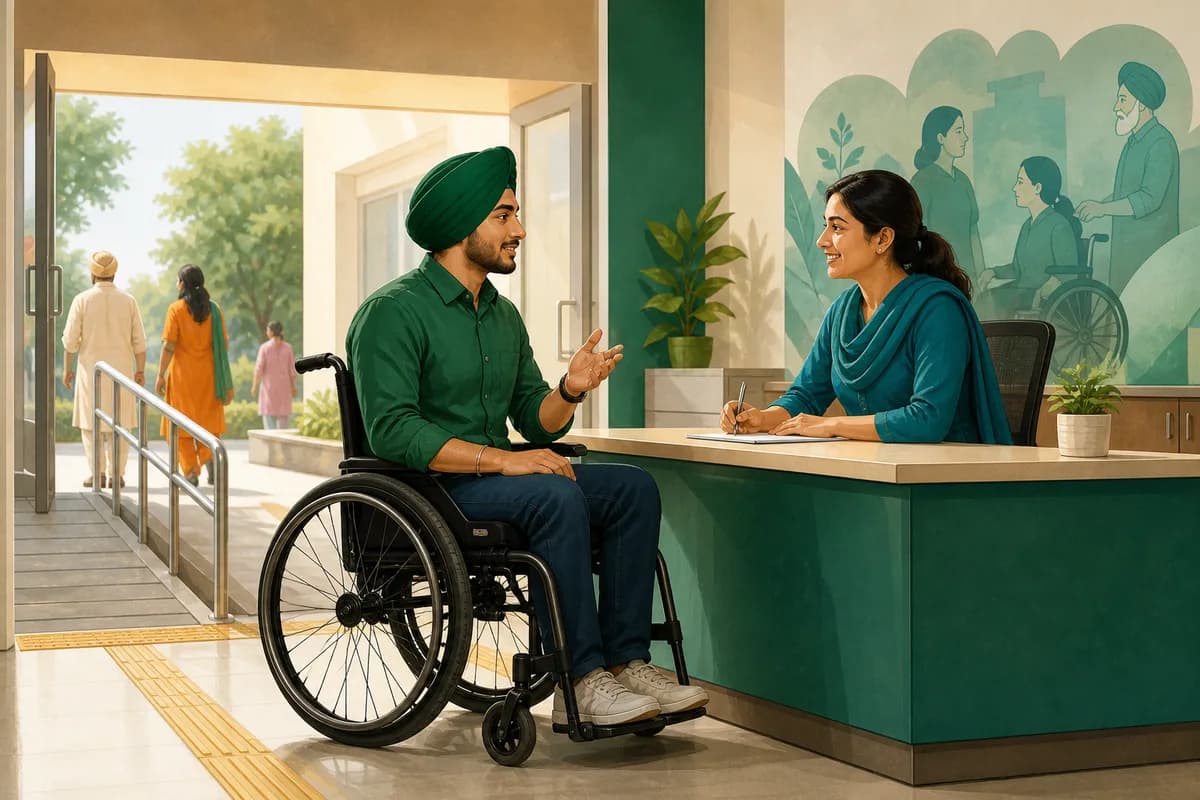
Scheme overview
Punjab's Disabled Person Pension service provides financial assistance after the Department of Social Security and Women and Child Development verifies the beneficiary's disability evidence and the other conditions recorded in the application. The form covers a broad range of physical, visual, hearing, speech, intellectual, neurological, blood-disorder and multiple-disability categories.
The person with disability may apply personally. Where another person applies, the form recognizes the mother, father or guardian and requests that person's identity and residence evidence. For a minor beneficiary, the official note says that either the father, mother or guardian must make the declaration.
The application captures disability type and percentage, Punjab residence history, annual income, Aadhaar and the beneficiary's own bank details. Approval is not based on a diagnosis name alone: the disability proof must come from a competent authority and the department also examines the declaration concerning income, work, property and tax status.
Benefits at a glance
- Recurring financial assistance after departmental approval
- Coverage across disability categories listed in the official Punjab form
- A parent or guardian application route where applicable
- ₹0 government fee and ₹0 facilitation charge on the official form
- Payment using the beneficiary bank account accepted during processing
Who may apply
Punjab residents with disability who hold proof issued by a competent authority and satisfy the department's current disability, income, employment, property and residence conditions. A mother, father or guardian may apply on behalf of the person with disability where applicable.
- The beneficiary is a person with disability residing in Punjab
- Disability type and percentage are certified by a competent authority
- Current departmental income, employment, land, property and tax conditions are satisfied
- Accepted age and residence evidence is available
- A parent or guardian can provide the additional evidence where the beneficiary does not apply personally
- The beneficiary's bank details can be verified
Department
Department of Social Security and Women & Child Development, Government of Punjab
Application fee
The official application form lists both the government fee and facilitation charge as ₹0.
Documents to prepare
- Accepted date-of-birth proof for the person with disability
- Disability proof issued by the competent authority
- Parent or guardian identity-cum-residence proof when the application is not made in self mode
- Completed self-declaration
- Copy of the first page of the beneficiary's bank passbook
- Self-attested photograph where required by the application mode
How to apply
- Review the official form and obtain a valid disability certificate from the competent authority
- Prepare the beneficiary's age, residence, declaration and bank documents
- Apply through Punjab Connect, a Punjab Sewa Kendra or another currently authorized departmental channel
- A parent or guardian may complete the declaration for a minor person with disability
- Keep the acknowledgement and the complete supporting file for verification
Before you submit the application
- Check that the disability certificate clearly records the beneficiary, disability and percentage.
- Use the beneficiary's bank details, as requested in the official form, and confirm the account is active.
- If a parent or guardian applies, prepare both the representative's and beneficiary's details.
- Read the entire self-declaration before signing and reconfirm its older financial thresholds.
- Keep the supporting file even after submission because the declaration says it may be requested later.
Disability certification, representative applications and the declaration
The competent-authority disability certificate is the foundation of this claim. It should identify the person correctly and record the nature and percentage of disability used by the department. The Punjab form lists numerous categories, including locomotor disability, cerebral palsy, muscular dystrophy, blindness, low vision, deafness, hard of hearing, speech and language disability, specific learning disability, autism spectrum disorder, chronic neurological conditions, multiple sclerosis, Parkinson's disease, haemophilia, thalassemia, sickle cell disease and multiple disabilities. A medical paper that describes treatment but is not the recognized disability proof may not meet this requirement. Ask the issuing medical authority or Sewa Kendra whether the certificate format and validity are acceptable before filing.
A representative application must keep the beneficiary and applicant roles distinct. The form asks for the representative's relationship to the person with disability and separately records the beneficiary's personal, disability, Aadhaar and bank details. When the beneficiary is a minor, a parent or guardian signs or gives the declaration. The self-declaration also contains means-related statements about employment, self-employment, land, annual income, commercial property, urban residential property and tax status. These statements must be truthful, but their monetary and property thresholds come from a form last revised in 2019. Ask the department to confirm that those limits remain operative, and preserve the full application file because the declaration requires it to be produced if requested later.
How to read the eligibility rules
Start with the eligibility conditions for Disabled Person Pension Scheme - Punjab, but do not treat any single condition as the whole test. Government schemes normally require every applicable condition to be satisfied together. A person may appear to fit the broad beneficiary description and still need to prove age, residence, family circumstances, registration status, income, contribution history or another scheme-specific fact. Read the checklist from beginning to end and mark each item as confirmed, uncertain or not applicable before spending time on the form.
Where this guide says that a requirement must be confirmed, that is deliberate. Department of Social Security and Women & Child Development, Government of Punjab remains the deciding authority, and an official may need to examine records that are not visible to an information website. If your circumstances sit near a threshold, or the official document does not publish the latest threshold, ask the department or authorized service centre to confirm the rule in force on the date you apply. Keep a note of the office, date and guidance received.
Preparing a reliable document file
A strong application file is consistent as well as complete. Compare the applicant's name, parent's or spouse's name, date of birth and address across identity documents, certificates and the bank passbook. Small differences such as initials, translated spellings, an old village address or a changed surname can cause a record to be held for clarification. If a correction is necessary, begin it before submitting Disabled Person Pension Scheme - Punjab; attaching several conflicting documents usually does not resolve the underlying mismatch.
Carry original documents for verification and keep clear copies for submission. Scan or photograph the complete page in good light, without cropped corners, glare or unreadable seals. For certificates, check the issuing authority, certificate number and date. For bank evidence, make sure the beneficiary's name, account number and IFSC are visible. Never hand over an original permanently unless an official written process specifically requires it, and never share an Aadhaar OTP, bank OTP, PIN, password or card security code with an agent.
Completing the application correctly
Use only the application route currently recognized by Department of Social Security and Women & Child Development, Government of Punjab. If assisted registration is available, the operator should enter information from your documents rather than guessing. Review every field before final submission, especially category, date of birth, relationship details, registration number, bank account and mobile number. A wrong category or transposed bank digit can affect both eligibility checking and payment. Ask for corrections while the application is still open instead of assuming they can easily be made later.
When a declaration appears on the form, read it before signing or authenticating. The declaration makes the applicant responsible for the information supplied and may permit verification against government databases. Do not omit an inconvenient fact or select an inaccurate answer merely to move past a required field. If the form does not provide a suitable option, ask the authorized centre how the case should be recorded. Submit every mandatory attachment and obtain an acknowledgement, receipt or application number before leaving.
What happens after submission
Submission is not the same as approval. The application may pass through document scrutiny, database matching, local verification and sanction by the competent authority. Some schemes also require confirmation from an educational institution, medical authority, labour office, local body or bank. Processing time therefore varies by case and workload. Use the acknowledgement number when asking for an update and allow the official channel a reasonable period before escalating a newly submitted application.
If the status shows a query, deficiency or objection, first obtain the exact reason. Correct that issue with the appropriate evidence rather than filing repeated duplicate applications. If an application is rejected, ask whether the system provides reconsideration, appeal or a fresh-application route and note any deadline. Keep the rejection message or order. It is far more useful for resolving the case than an informal statement that the application “did not work.”
Frequently asked questions
Can a parent apply for a child with disability?
Yes. The official form permits a mother, father or guardian to apply, and specifically requires one of them to declare where the person with disability is a minor.
Is a disability certificate mandatory?
Yes. Proof of disability issued by the competent authority is listed as mandatory.
Does the form charge a fee?
No. The form lists a government fee of ₹0 and facilitation charges of ₹0.
Which disability categories appear on the form?
The form includes physical, visual, hearing, speech and language, intellectual, neurological, blood-disorder and multiple disabilities, with several listed subtypes.
Is the ₹60,000 income figure definitely current?
It appears in the self-declaration of the official form, but that form is marked last revised in February 2019. Confirm the operative threshold before applying.
Official source and verification
We reviewed the government material linked below and summarized it in plain language. Scheme rules, amounts, deadlines and service channels can change; use the official source for the final check before applying.
Visit the official government source
Related Punjab schemes
Continue comparing verified guidance before deciding which programme matches your circumstances.
Mukhya Mantri Sehat Yojana Punjab
Punjab's universal health scheme providing eligible resident families cashless hospitalization cover of up to ₹10 lakh per family per year at empanelled government and private hospitals.
View scheme guide
Mukh Mantri Mawan Dheeyan Satkar Yojana
Punjab's monthly financial-assistance scheme for eligible women aged 18 or above: ₹1,500 for Scheduled Caste women and ₹1,000 for women in other categories.
View scheme guide
Old Age Pension Scheme - Punjab
Punjab's social-security pension service for eligible older residents, with official application routes and receipt-based guidance for checking an application or beneficiary status.
View scheme guide